How to Find a Credible Architect or Interior Design Firm in India?
Written by
Sumith Tilokani
Published on
30th July 2026
SHARE
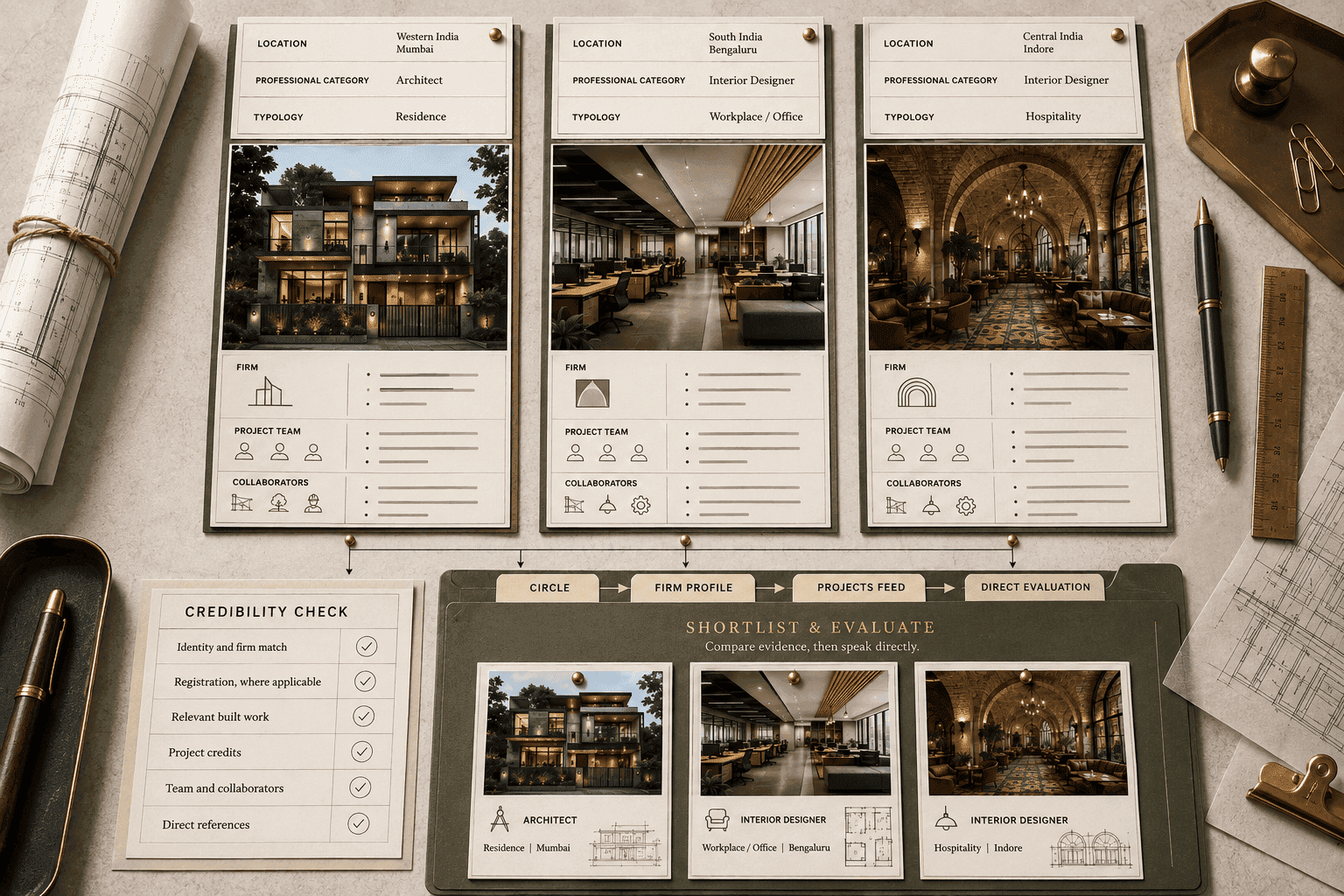
A credible architect or interior design firm is not found through a “best firm” list. Build a shortlist from evidence you can inspect: the correct professional category, location relevance, real completed work, comparable project typology, named project credits, the team behind the work and a direct conversation about scope and responsibility. In India, also verify an architect’s registration through the Council of Architecture. ARCZ supports this research through Circle, firm profiles and the Projects feed, but verification and portfolio evidence are starting points - not guarantees of suitability or project outcome.
At a glance
-
Start with the role: Decide whether the requirement needs an Architect, Interior Designer or another built-environment professional.
-
Use location deliberately: Look for firms based in the project city or with credible work executed there.
-
Check formal status where applicable: For an architect in India, search the Council of Architecture online directory.
-
Read built work as evidence: Compare completed projects by type, scale, context and level of involvement - not only by visual style.
-
Trace attribution: Confirm which firm, professionals, team members and collaborators are credited on the project.
-
Inspect the firm profile: Review the practice description, project range, linked professionals and contact information.
-
Evaluate directly: Ask who will lead the project, what is included, how decisions are documented and how the appointment will be structured.
-
Primary ARCZ pathway: Begin with Circle, open firm profiles and cross-check the work through the Projects feed.
What “credible” should mean in a shortlist
Credibility is not the same as popularity, taste or a polished presentation. For this decision, a credible firm is one whose identity, professional category, location, work, people and role in projects can be checked. The evidence should also be relevant to the project you are planning. A firm may be credible in general yet still be the wrong fit for a specific city, typology, scale, service scope or working relationship.
ARCZ verifies firms before they appear in Circle and reviews projects before publication. It also links professionals to firms and records project teams and collaborators where supplied and verified. That improves traceability, but it does not guarantee commercial performance, availability, fees, compatibility or project outcomes. A responsible shortlist combines platform evidence with direct due diligence.
Step 1: define the professional category before searching
The first mistake in professional discovery is searching for a broad label before defining the work. A new building, an interior fit-out, a landscape intervention, structural design and turnkey execution are different requirements. The shortlist should begin with the professional category that matches the responsibility you need.
-
Architect: Appropriate when the requirement involves building design, planning, additions, retrofits or architectural coordination.
-
Interior Designer: Appropriate when the primary scope is spatial planning, interiors, materials, furniture integration or interior execution support.
-
Landscape Architect: Relevant for site planning, planting, hardscape, softscape and external-space design.
-
Consultants and delivery specialists: Structural, MEP, project management, quantity surveying, contracting and specialist services may require separate or coordinated appointments.
A firm can work across more than one discipline, but the profile and project credits should show where that capability comes from. Do not assume that every practice displaying attractive interiors provides full architectural services, or that every architecture firm undertakes turnkey interior execution.
Step 2: use location as a relevance filter, not a quality score
Location affects site access, consultant coordination, regional processes, contractor networks and the practical frequency of meetings. Begin with the project’s execution city. Then distinguish between a firm’s base location and the locations where it has completed relevant work.
A local office can be useful, but proximity alone does not prove capability. Conversely, a firm based elsewhere may have meaningful experience in the project city. The stronger question is: can the firm show relevant built work there, explain how it coordinates locally and identify who will be responsible for site engagement?
On ARCZ, Circle supports location-and-category discovery, while project records show the execution location of individual work. Use both views rather than treating one city label as the whole answer.
Step 3: verify the architect’s registration in India
For an architect, check formal registration separately from portfolio research. Under the Architects Act, 1972, an “architect” is a person whose name is entered in the register, and the Council of Architecture maintains the register. The Council provides an online directory that can be searched by name, registration number, state, city or pincode.
This check applies to the protected title and registration of architects; it should not be presented as a universal licence check for every design or contracting category. Interior design firms, contractors and specialist consultants may be assessed through different credentials, experience, company records, project evidence and references depending on the service being appointed.
Registration establishes formal status. It does not tell you whether the professional has experience in your typology, will personally lead the work, has current capacity or is commercially suitable. Those questions require the next layers of evaluation.
Step 4: begin with real built work, not a moodboard
A credible portfolio should help you understand what was actually designed or delivered. Look for completed project photographs, a coherent project description, location, project type, firm attribution and named credits. Renders and concept images can explain design intent, but they should not be treated as equivalent to completed work.
Do not judge the whole practice from one hero image. Open several projects and look for consistency across entrances, circulation, planning, material junctions, lighting, storage, landscape, services and the relationship between photographs. The aim is not to find a style you can copy. It is to see whether the practice repeatedly resolves the kinds of conditions your project will create.
Step 5: compare the right typology, scale and complexity
A project becomes useful evidence when it is comparable. A compact office fit-out, a multi-generational residence and a hospitality project involve different briefing, coordination and delivery demands. Compare firms through the work closest to your own decision, while allowing for adjacent experience that genuinely transfers.
-
Typology: Residential, office, commercial, hospitality, healthcare, institutional and other sectors create different user and coordination requirements.
-
Scale: Area alone does not define complexity, but it helps prevent comparisons between fundamentally different assignments.
-
Project stage: New build, renovation, fit-out and work within an existing structure call for different problem-solving experience.
-
Responsibility: Determine whether the firm handled architecture, interiors, coordination, execution support or only a limited portion of the displayed work.
-
Context: City, site, climate, existing conditions and operational constraints can matter as much as the visual result.
Step 6: trace the firm, team and project credits
The name attached to a project card is only the beginning. Open the project record and identify the credited firm, team members and collaborators. Then open the firm profile to see whether those professionals are linked to the practice and whether the project sits within a broader body of work.
Credits help answer three different questions: who the project belongs to, who worked on it and which external disciplines were involved. They also reveal whether the expertise you admire is part of the current firm structure or was associated with a particular team. Before appointment, ask who from the displayed team will actually work on your project.
Three fresh ARCZ evidence chains - and how to read them
The examples below are not rankings or endorsements. They show how different ARCZ records can be used as evidence when building a shortlist.
JAD Arch Studio: a compact office record with named interior-design credits
The ARCZ project page for JAD ARCH STUDIO records an Office project in Vadodara with an area of 1,000 sq.ft. The project is attributed to JAD Arch Studio, and the team section credits Arpit Jain and Surbhi Agarwal as Interior Designers. For someone researching a workplace or compact studio interior, the useful evidence is not the firm name alone: it is the combination of typology, area, firm attribution and named team roles.
Studio Design Charrette: residential scale and a multi-person architecture team
The House of Three Generations is recorded as a 5,800 sq.ft Residential project in Vadodara by Studio Design Charrette. The team credits Mansi Patel, Sharad Patel and Adarsh Chaturvedi as Architects. This gives a prospective residential client several evidence points to investigate: comparable use, scale, project location and the architecture team connected to the work.
Marigold Interiors: a commercial interior with a direct team credit
The CA office page records a 900 sq.ft Commercial project in Ahmedabad by Marigold Interiors, with Kshama Parmar credited as Interior Designer. A prospective client can use that chain to evaluate whether the practice has relevant workplace experience and then ask directly about scope, constraints, responsibilities and who would lead a new assignment.
These records make a shortlist more traceable. They do not prove that one firm is better than another, that the credited person is available, or that a similar-looking result will suit a different brief. The next step is direct evaluation.
Step 7: read the firm profile as a practice record
A firm profile should help you move from one appealing project to the practice behind it. Review the firm’s category, base location, description, linked professionals, project range and contact information. Look for patterns: repeated typologies, breadth versus specialisation, geographic reach, team structure and the consistency of project credits.
A sparse profile is not automatically a weak practice, and a large portfolio is not automatically a stronger one. Treat profile completeness as one evidence signal. When information is missing, ask for it directly rather than filling the gap with assumptions.
Step 8: create a shortlist based on reasons you can state
A useful shortlist usually contains a small number of firms selected for explicit reasons. Three to five is often manageable for direct conversations, but the right number depends on the project and procurement process. The important part is that every firm has a documented reason for inclusion.
- Category fit: The firm provides the professional service the project needs.
- Location fit: The firm is based locally or can demonstrate relevant executed work and coordination in the city.
- Typology fit: The portfolio contains projects with transferable users, constraints or operational needs.
- Evidence quality: Completed work, descriptions and credits are traceable.
- Team fit: The likely project lead and delivery team can be identified.
- Working fit: The first conversation indicates clear communication, realistic expectations and alignment on scope.
Do not use follower counts, likes, advertising position or a universal “top architect” label as shortlist criteria. ARCZ discovery is not sold through paid ranking or visibility boosts; firms should be compared through their work and profile evidence.
Step 9: evaluate the shortlisted firms directly
The direct conversation is where portfolio research becomes appointment due diligence. Ask the same core questions to each shortlisted firm so the answers can be compared fairly.
-
Who will lead the project? Ask for the principal contact and the people expected to work on design, coordination and site stages.
-
Which similar project is most relevant? Ask why it is comparable and what the firm learned from it.
-
What is included and excluded? Clarify design stages, drawings, approvals support, consultant coordination, site involvement, procurement and execution responsibilities.
-
What information is needed before a proposal? A responsible firm should identify gaps in the brief rather than quote from incomplete information.
-
How will decisions and changes be documented? Establish the process for approvals, revisions, meetings and issue tracking.
-
What external consultants are required? Confirm who appoints and coordinates structural, MEP, landscape, lighting or other specialists.
-
What is the fee structure and payment sequence? Compare like-for-like scope, deliverables, taxes, reimbursables and exclusions - not only the headline fee.
-
Can relevant references be provided? Seek permission-based references where they would materially reduce uncertainty.
-
What agreement will govern the appointment? The Council of Architecture notes that an architect’s project engagement is carried out according to the agreement executed between client and architect. A written agreement is also prudent for interior-design and related appointments.
Common shortlisting mistakes
-
Starting with “best architect near me”: The query produces rankings and promotions before it establishes your actual criteria.
-
Choosing from one photograph: A single view cannot show planning, detailing, coordination or the firm’s role.
-
Comparing unrelated projects: A luxury residence may be poor evidence for a compact clinic, office or renovation.
-
Assuming every project image is built work: Separate completed photographs from renders and concepts.
-
Ignoring credits: The person or firm you admire may not be the party responsible for the aspect you value.
-
Ignoring the current team: A past project does not confirm who will work on the new one.
-
Treating registration as the whole decision: Formal status is essential where applicable, but it does not replace project and team evaluation.
-
Selecting only on the lowest fee: A lower headline number may represent a different scope, fewer deliverables or more exclusions.
-
Skipping the written appointment: Unclear scope, responsibilities and decision rights create avoidable disputes.
Which ARCZ pathway should you use?
-
Use Circle when: you want to discover verified firms and firm-linked professionals by location and category.
-
Use a firm profile when: you want to understand the practice, linked team, project range and direct contact information.
-
Use the Projects feed when: you want to begin with real built work and follow a project back to its firm and credits.
-
Use Post a Brief when: your requirement is ready and you want one structured brief routed to relevant verified firms rather than contacting them individually.
What this method can - and cannot - establish
This framework can create a more defensible shortlist because the reasons for inclusion are visible: location, category, built work, typology, team and credits. It can also expose gaps that should be discussed before appointment.
It cannot guarantee design quality, cost, availability, programme, statutory approvals, execution quality, professional compatibility or project outcome. ARCZ verification, Council of Architecture registration, project records and references each answer different questions. A final appointment still requires direct evaluation and a clearly documented agreement.
Frequently asked questions
How do I find a reliable architect in India?
Define the project type and city, verify the architect’s registration through the Council of Architecture, review comparable completed work, trace the firm and team credits, and interview a small shortlist using the same scope and responsibility questions. Reliability is assessed through combined evidence and direct evaluation; no directory or ranking can guarantee it.
How should I shortlist interior designers?
Shortlist interior designers whose completed work is comparable in typology, scale and level of responsibility. Check whether the firm handled design only, coordination, procurement support or turnkey execution; identify the team that delivered the projects; and compare written scope, deliverables, exclusions and fee structure before appointment.
Should I choose a local architect?
Local presence can make site engagement and coordination easier, but it is not a quality score. Consider firms based in the project city and firms with meaningful executed work there. Ask how often the team will visit, who handles local coordination and whether the appointment includes site-stage responsibilities.
How many firms should I shortlist?
A shortlist of three to five firms is often practical for direct comparison, although complex or formally procured projects may require a different process. Keep the list small enough to conduct meaningful conversations and large enough to compare approach, scope, team and commercial terms.
Are Instagram photos enough to evaluate a firm?
No. Social images can provide inspiration, but they may not show whether the work was built, who designed it, what the firm’s role was or which team delivered it. Use project pages, credits, firm profiles, registration checks where applicable and direct questions to establish those facts.
Does a verified ARCZ profile guarantee the firm?
No. ARCZ verifies firms before they appear in Circle and reviews projects before publication, which improves traceability. Verification does not guarantee suitability, availability, commercial performance or project outcome. It should be combined with direct due diligence.
What should I ask for before accepting a proposal?
Ask for the proposed team, detailed scope, deliverables, exclusions, stages, programme assumptions, consultant responsibilities, site involvement, fee basis, taxes, reimbursables, payment milestones and the form of agreement. Compare proposals only after aligning their scope.
How do I know who actually worked on a project?
Open the project record and review the named team and collaborator credits, then cross-check the firm profile. Ask the firm to explain each party’s role and whether the same people will be involved in the proposed project.
Build the shortlist through evidence, then make the decision directly
A credible shortlist is a set of firms you can explain, not a list copied from a ranking page. Start with the correct category and project city, verify formal status where applicable, compare relevant built work, trace the team and credits, and then evaluate the shortlisted firms through the same direct questions.
Explore verified firms and firm-linked professionals in ARCZ Circle, then use firm profiles and the Projects feed to examine the work behind each option.
Sources and update record
-
Council of Architecture - Architects Professional Guidelines
-
Studio Design Charrette profile and The House of Three Generations project
-
ARCZ Insights Editorial, SEO & AI Citation Master Manual - Version 4.1.
Last checked: 29 July 2026. Review this article every six months, and immediately after a material change to ARCZ verification, Circle, firm profiles, project credits, professional categories or the Council of Architecture directory and registration framework.