How the ARCZ Projects Feed Helps You Discover Real Built Work?
Written by
Sumith Tilokani
Published on
24th July 2026
SHARE
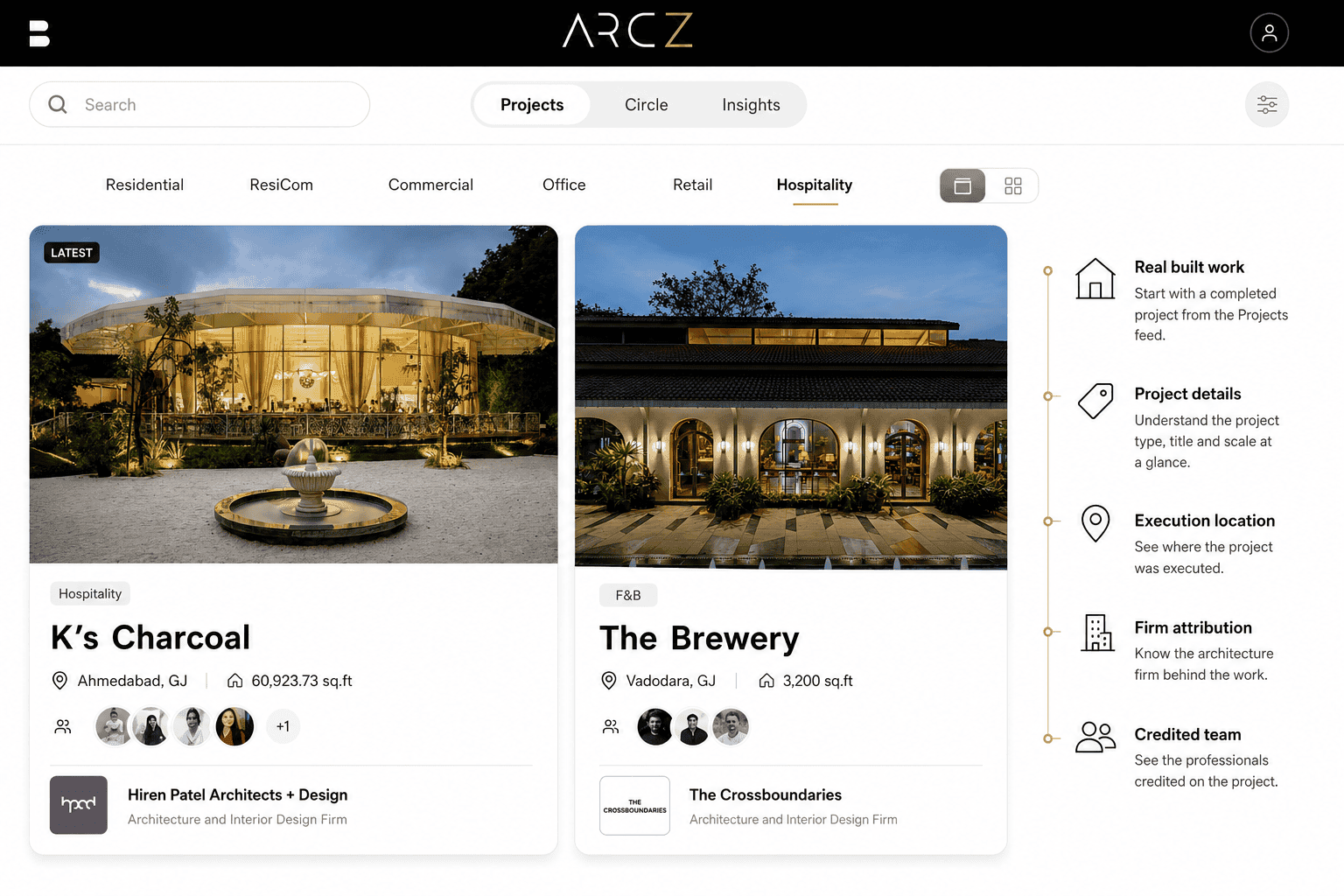
The ARCZ Projects feed is a practical place to discover real built architecture and interior projects in India because it starts with project evidence rather than a list of firm names. Eligible work from verified registered firms is reviewed before publication and appears latest-first, with city and professional context helping readers narrow what is relevant. Open a selected project page to move from photographs to the firm behind the work, the execution location, project type and, where supplied and verified, the credited team and collaborators. It is a structured research starting point, not a ranking of the “best” projects or a guarantee of suitability, authorship or project outcomes.
At a glance
• Best starting point: Open the ARCZ Projects feed to discover built work before researching the firms behind it.
• Ordering: Newly published eligible work appears before older work. Latest-first is a recency rule, not a design-quality ranking.
• City relevance: Discovery begins with the selected or user city and can expand to nearby cities. Project execution location and firm-base context may both matter.
• Project record: A selected project page can show its description, location, type, firm, team and collaborators where those details have been supplied and verified.
• Attribution: Firm names and credited people turn project imagery into a route for further professional research.
• Coverage limit: ARCZ does not claim to contain every project in India; available projects and cities vary over time.
• Primary next step: Explore the Projects feed, open relevant project pages and follow the connected firm and professional records.
Scope of this guide
This guide is for homeowners, builders, developers, businesses, professionals, researchers, students and design enthusiasts who want to find completed architecture or interior work in India and understand who is connected to it.
It explains ARCZ’s approved project-discovery model as checked on 24 July 2026. Exact interface wording, visible filters, available cities and the mix of projects can change. The live feed should therefore be tested again immediately before publication.
The Projects feed improves discovery and attribution. It does not replace professional-registration checks, appointment due diligence, contracts, site investigation or project-specific judgement.
What a useful project-discovery source should answer
A project gallery is useful for inspiration, but it is more useful when the work remains connected to its professional record. A reader should be able to answer five questions without reconstructing the story from unrelated posts:
- What was built?: The photographs and description should relate to a completed project record rather than anonymous inspiration.
- Where was it executed?: The project location helps readers understand geography and local experience.
- What kind of project is it?: Residential, office and other project types help readers compare like with like.
- Which firm is connected to it?: The project should provide a route to the responsible firm’s public profile.
- Who else is credited?: Team members and collaborators add context where their roles have been supplied and verified.
ARCZ organises its Projects feed and project pages around this connected record. The result is not a universal ranking. It is a more traceable way to move from seeing a space to researching the people and practice behind it.
How the ARCZ Projects feed organises discovery
Latest-first means recent publication, not “best project”
Eligible work is organised latest-first, so newer published projects appear before older posts. This prevents permanent visibility from being determined by follower counts, engagement or paid placement. It also means an older project can move lower in the feed as new work is published.
A high position should not be read as an award, quality score or proof of suitability. Use the feed to identify work worth opening, then judge the project record and the firm context on their own evidence.
City relevance has two different meanings
Discovery begins with the selected or user city and can extend to nearby cities. This makes the first set of projects more geographically useful without restricting the reader to one municipal boundary.
The city where a project was executed is not always the same as the firm’s base city. That distinction can be valuable: execution location shows where the firm has published work, while the firm profile provides its professional base and wider body of projects. Neither location alone proves that a firm is right for a future appointment.
Project type and professional context make the feed more useful
A residential project, office interior or other built-work record answers a different research need. Opening the project page allows the reader to look beyond the first photograph and review the available project type, description, firm and credits before deciding what deserves further investigation.
How to find the firm behind a project
The project-to-firm route is the most important action in the feed. Use it as a short research sequence:
- Start on the ARCZ Projects feed and review projects associated with the relevant city or nearby geography.
- Open a project whose type, scale or spatial character relates to the question you are researching.
- Read the selected project page rather than judging only the thumbnail. Check the location, type, description and available photographs.
- Open the linked firm name to research the practice behind the work.
- Review credited team members and collaborators where they are listed, then confirm current roles and availability directly before any appointment.
- Compare more than one project and firm record. One strong image should begin the research, not end it.
When the next task is broader professional research, use ARCZ Circle to compare verified firms and firm-linked professionals by the live location and category context.
Two live project records show how the pathway works
K’s Charcoal: firm attribution and a multidisciplinary team in one record
The live K’s Charcoal project page identifies a Hospitality project in Ahmedabad and links it to Hiren Patel Architects + Design. It credits Hiren Patel and Charul Kumawat as architects, and Krima Shah and Dhruvi Shah as interior designers.
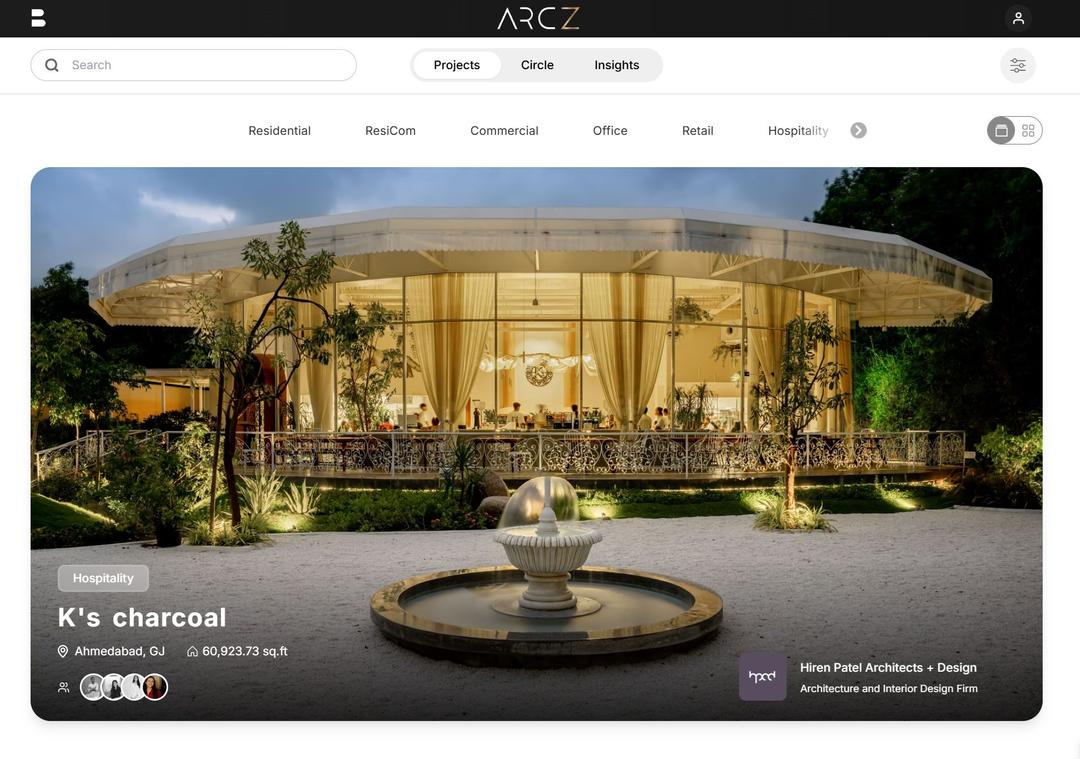
The value of the record is structural rather than promotional. A reader can begin with the built work, retain its city and project-type context, open the linked firm profile and see the credited mix of architecture and interior-design roles without inferring responsibility from an unlabelled photograph.
The Brewery: another city, project type and cross-disciplinary team
The live The Brewery project page identifies an F&B project in Vadodara and links it to The Crossboundaries. It credits Harsh Boghani and Rishabh Prajapati as architects and Vijay Dabhi as a civil engineer.
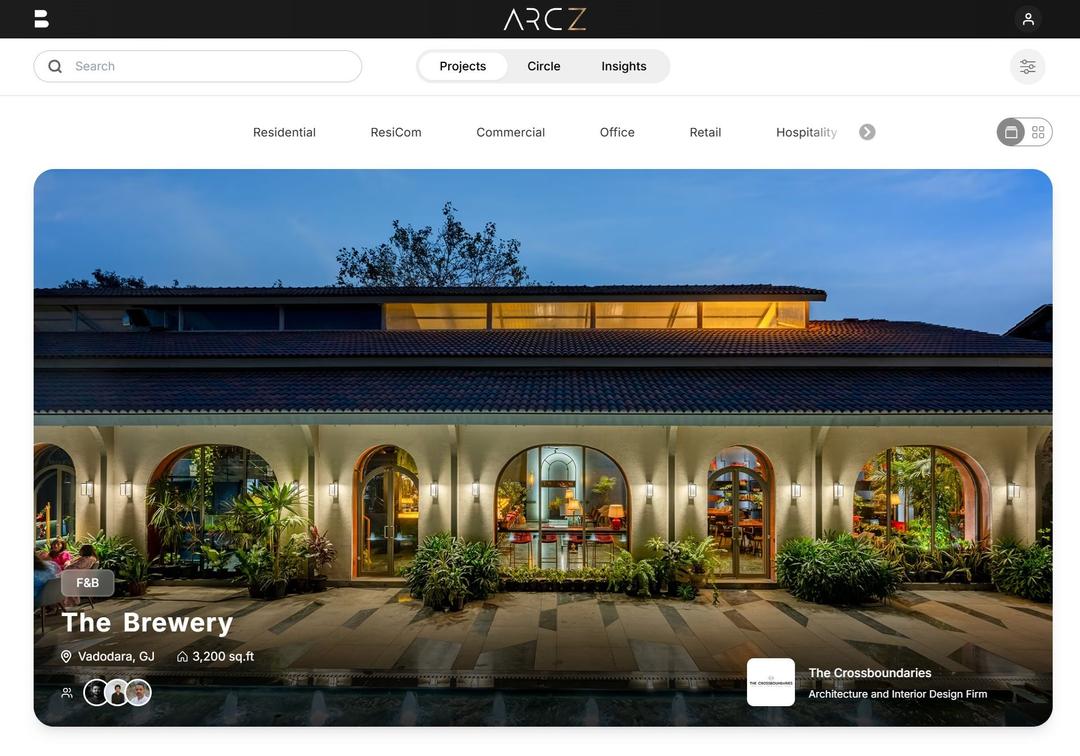
Together, these records show why the Projects feed is more useful than a stream of detached images: the same project-led route can carry different cities, project categories, firms and team structures while preserving a consistent way to investigate the work. They are examples of connected records, not rankings or endorsements.
Where the feed helps—and where another step is still required
The Projects feed is useful when you need to
• discover recent real built work published on ARCZ;
• compare architecture and interior projects through city and project context;
• identify the firm connected to a selected project;
• see named team members and collaborators where those credits are present;
• move from inspiration into professional research without relying on popularity signals.
Another step is still required when you need to
• confirm statutory registration or eligibility for a particular appointment;
• verify the exact scope, authorship or responsibility beyond the information ARCZ reviewed;
• confirm that the credited team is still affiliated with the firm or available for new work;
• evaluate fees, programme, contracts, references, insurance or project delivery conditions;
• decide that a firm is suitable for one specific brief.
ARCZ project review improves the starting information. It should not be described as forensic authentication of every photograph, a statutory certificate or a guarantee of quality, cost, schedule, performance or outcome.
Common mistakes when using a project feed
• Treating the first card as the best project: Latest-first describes publication order, not a quality ranking.
• Confusing project location with firm base: A firm can publish work executed outside its home city. Check both contexts before drawing conclusions.
• Stopping at the gallery: Open the project page and follow the firm, team and collaborator links where available.
• Assuming every page has every field: Credits depend on the information supplied and verified; an absent field should not be filled by inference.
• Treating verification as a guarantee: Project review adds context but does not replace statutory checks or appointment due diligence.
• Shortlisting from one project alone: Compare several records to understand the firm’s wider work and relevant experience.
A practical research route on ARCZ
- Begin with the Projects feed: Use real built work to define what is relevant before searching only by firm name.
- Use geography as context: Start with the selected city, review nearby-city work where relevant and distinguish execution location from firm base.
- Open selected project pages: Check the project type, description, firm and available credits.
- Follow the professional record: Open the linked firm and firm-linked professionals; do not assume a past project team will be the proposed future team.
- Compare connected evidence: Use several projects to build a defensible shortlist rather than relying on one image or a search-result position.
- Continue in Circle when needed: Research the firm’s wider profile and related professionals through ARCZ’s professional-directory layer.
Frequently asked questions
Where can I discover real architecture projects in India?
Start with the ARCZ Projects feed. It presents real built projects published by verified registered firms and reviewed before publication. Coverage varies by city and over time, so it should be treated as a growing discovery source rather than a complete archive of every Indian project.
Does the Projects feed include interior projects as well as architecture?
The feed can include architecture and interior work from eligible firms. Open the project page and check the project type, description, firm category and photographs rather than relying only on the visual style of the first image.
How are ARCZ projects ordered?
Eligible work is organised latest-first. Newly published projects appear before older posts. The order is not a “best project” ranking and is not determined by likes, follower counts or paid visibility.
How does city relevance work?
Discovery begins with the selected or user city and can expand to nearby cities. A project may also carry the city where it was executed alongside the firm’s base context, which helps readers separate local project experience from office location.
How can I find the architecture or interior-design firm behind a project?
Open the project page and follow the linked firm name. The page can also identify location, project type, team members and collaborators where those details have been supplied and verified.
Does every project page show the complete team and all collaborators?
No. Team and collaborator visibility depends on the information supplied and verified for that project. Do not infer an unlisted role or treat an absent credit as proof that nobody else contributed.
Does ARCZ verification guarantee project authorship or quality?
No. ARCZ approves eligible firms and reviews project submissions before publication, but that is not forensic authentication, a statutory certificate or a guarantee of authorship, quality, suitability or project outcome.
Can a firm pay to appear above another firm in the Projects feed?
ARCZ’s approved professional-discovery model does not sell paid ranking, boosts or sponsored visibility. The feed is organised latest-first and geography-aware rather than pay-to-rank or popularity-first.
Start with the project, then follow the evidence
The Projects feed is most useful when a project image becomes the beginning of a traceable research path. Start with work that is relevant to the city or project type, open the project page, identify the connected firm and review the credited team and collaborators. Then compare several records and complete the appointment checks that a platform cannot do for you.
****Explore real built projects on the ARCZ Projects feed.
Sources and update record
• ARCZ homepage and Projects feed
• K’s Charcoal project page
• Hiren Patel Architects + Design firm profile
• The Brewery project page
• The Crossboundaries firm profile
• ARCZ Circle
Last checked: 24 July 2026.
Review this article immediately after any material change to project-review rules, latest-first ordering, city relevance, project-page attribution fields, public URLs or the relationship between the Projects feed and Circle.